
Choosing Professional Nail Nippers is not just a matter of picking the sharpest tool. The right design depends on the task, the user’s control, and how the instrument feels in hand. A narrow jaw can offer precision around small edges. A broader, curved jaw may suit thicker toenails better. The hinge should move smoothly, while the handles should rest securely between the fingers. Small details matter.
Nail-industry scientist Doug Schoon is a respected source on nail structure and professional nail care. I could not verify a direct Schoon quotation about nippers, so this guide does not attribute one to him. Its editorial rule is simple: “Choose for controlled cutting, not maximum force.” A useful rule.
The sections ahead compare common types, including straight-jaw, curved-jaw, and precision nippers. They also consider stainless-steel construction, spring mechanisms, handle comfort, and cleaning between uses. These differences show up during real work: a tool may pinch, slip, or cut unevenly when its shape does not match the task. Even a well-made nipper can feel awkward in an unfamiliar hand. That matters, and it deserves an honest test rather than a confident label. This guide explains what to look for, where each type performs well, and which trade-offs deserve attention before purchase.
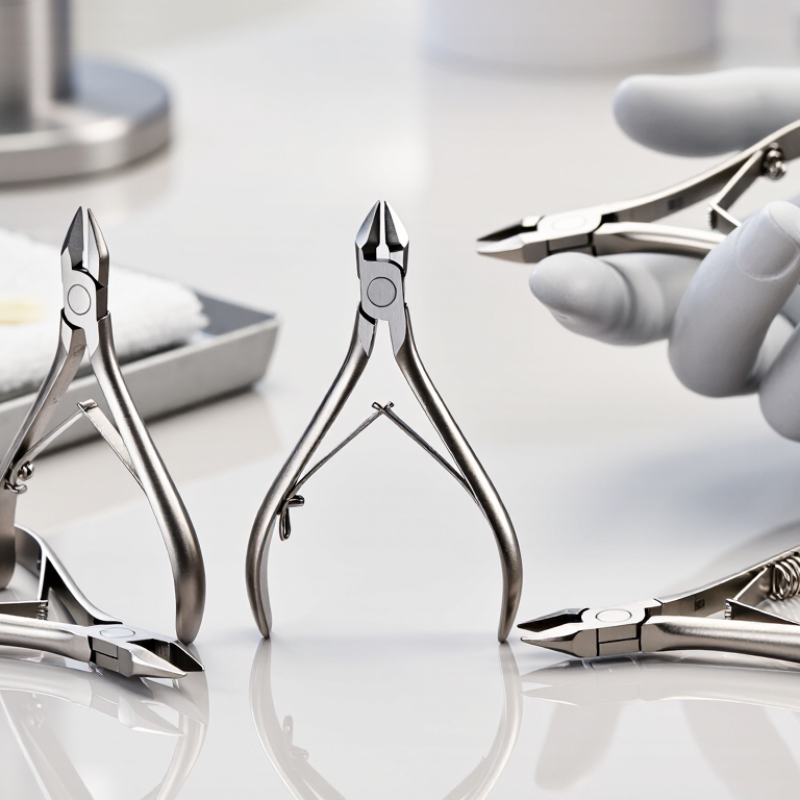
What Are the Best Types of Professional Nail Nippers?
What Professional Nail Nippers Do: Blade Design, Leverage, and Jaw Types
Professional nail nippers work best when their blade and jaw match the task. A narrow, pointed jaw can reach small hangnails, while a wider jaw gives better support when trimming thicker nails. Look for blades that meet evenly, without a visible gap or snagging edge. The hinge should move smoothly, and the handles should feel steady rather than pinching your fingers. Spring design matters, too: a double spring may open the handles more evenly, while a single spring can feel simpler. Neither is automatically better. Fit matters.
Tips: Test the nippers on a clean, dry nail before detailed work. Use small cuts, and keep the blades aligned with the nail edge. Don’t pull at loose skin.
Leverage comes from the relationship between handle length, hinge, and jaw. Longer handles can make firm cuts easier, but they may feel less controlled in small areas. For precise cuticle work, a compact jaw and light pressure usually offer better control. For thicker toenails, choose a sturdier, broader jaw and trim gradually. Even a sharp tool can slip. A common mistake is buying the largest jaw for every job; that extra reach can make delicate trimming awkward. Reassess the fit after a few careful uses.
This simplified single-pivot model compares 60, 75, and 90 mm force-point distances from the pivot, with the jaw cutting point fixed 10 mm from the pivot. Ideal mechanical advantage is calculated as handle-arm length ÷ jaw-arm length; real nippers vary, and friction is not included. Blade shape and jaw width or profile should be chosen to suit the cut and nail.
Cuticle, toenail, and ingrown-nail nippers have different jobs. Cuticle nippers have small, fine jaws for trimming loose, dead cuticle or a hangnail. They should not cut living skin around the nail; that tissue helps protect against infection. Toenail nippers are sturdier, with wider jaws that can manage thicker nails. Trim straight across, using small cuts rather than forcing the blades through a hard nail.
Small details matter.
Ingrown-nail nippers usually have narrow, pointed blades for reaching a nail edge. That precision can also make them easy to misuse. Avoid digging into the skin or cutting deeply into the corner; painful swelling, drainage, or redness warrants medical advice, especially for people with diabetes or reduced circulation. A systematic review and meta-analysis by Gupta and colleagues, published in the Journal of the European Academy of Dermatology and Venereology in 2017, estimated global onychomycosis prevalence at 5.5%. Thick nails are not always fungal, though. Keep nippers clean, dry, and disinfected according to professional guidance, and do not share them. The distinction between dead cuticle and living skin can be easy to miss.
That deserves care.
Jaw length determines how much of the nail edge a professional nipper can reach in one controlled cut. Short jaws suit small corners and thick toenails, where a broad bite may remove too much. Longer jaws can follow a curved edge with fewer repositionings, but they demand steadier alignment. There is no universally accepted jaw-length cutoff for precision; hand size, nail thickness, and the service matter. Small details matter. Under bright task lighting, compare the jaw tips: they should meet evenly, without a visible gap or sideways twist.
Spring style changes control, too. A single-leaf spring gives a firm, direct return; a double spring can feel lighter across repeated cuts, though it may open wider than some users expect. Test both with dry hands. The handles should return smoothly, without snapping into the palm. NIOSH’s 1997 report, Elements of Ergonomics Programs, identifies repetition, force, and awkward posture as workplace risk factors. Applied to nail work, that finding supports choosing a spring that reduces squeeze effort while keeping the wrist straight. It is not a precision guarantee. A spring that feels easy in a shop may feel tiring after many clients, so real use should guide the choice.
| Nipper Type | Typical Jaw Length | Common Spring Style | Effect on Precision and Handling | Best Suited For | Main Trade-Off |
|---|---|---|---|---|---|
| Short-jaw nipper | About 3–5 mm | Single- or double-leaf spring | A compact cutting edge is easier to position for small, controlled cuts. The shorter jaw can feel more precise in tight areas, though it removes less material per cut. | Detailed cuticle work and small areas where close control matters. | May take more cuts on thicker or larger areas of dead cuticle. |
| Medium-jaw nipper | About 5–7 mm | Single- or double-leaf spring | Balances reach, visibility, and cutting capacity. It is a versatile size for many routine manicure tasks. | General professional manicure work and users seeking an all-purpose size. | Less specialized than a very short jaw for tight detail or a longer jaw for broader trimming. |
| Long-jaw nipper | About 8–10 mm | Single- or double-leaf spring | The longer cutting edge can cover more of a target in one pass. It may be less maneuverable in narrow areas, so careful positioning is important. | Broader trimming tasks where a longer cutting edge is useful. | Can be harder to place precisely around small or curved details. |
| Single-spring nipper | Available with short, medium, or long jaws | One spring leaf opens the handles after each cut. | Offers a straightforward opening action. The required hand effort depends on the spring tension, handle shape, and joint—not spring count alone. | Users who prefer a simple spring mechanism and a familiar handle response. | Opening feel and return force vary by construction; a single spring is not automatically easier to use. |
| Double-spring nipper | Available with short, medium, or long jaws | Two spring leaves return the handles toward the open position. | Provides a spring-assisted return after cutting. Smoothness depends on alignment, spring tension, and maintenance. | Repeated cutting where a spring-assisted handle return is preferred. | More spring parts can require cleaning and inspection; the added spring does not guarantee greater precision. |
| Springless nipper | Available with different jaw lengths | No return spring; the user opens the handles manually. | Direct handle movement can suit users who prefer to control both opening and closing themselves. | Those who favor a simpler mechanism or a manually controlled opening action. | Requires the user to reopen the handles between cuts, which may slow repetitive work. |
Selection note: Jaw-length ranges are practical examples, not universal industry standards; manufacturers may measure jaws differently. For precise work, match the jaw to the target area and choose a tool that opens smoothly, aligns evenly, and feels controllable in the hand. Nippers should be used on appropriate dead cuticle or nail material, not living skin.
Stainless steel is a practical starting point when choosing professional nail nippers, but the label alone tells little. ISO 7153-1 provides a reference for materials used in surgical instruments, including stainless-steel grades. It can help buyers ask precise questions about material selection. It does not, by itself, certify a nail nipper or guarantee its performance. Check whether the supplier identifies the steel grade and provides supporting documentation.
In daily use, corrosion resistance matters around water, skin oils, and cleaning products. Stainless steel can still stain or corrode if it is poorly maintained. Wipe nippers dry after cleaning, and inspect the joint for residue or rough movement. Small details matter. A smooth hinge and even blade meeting often reveal more about usable quality than a polished surface does.
Steel is only one part of the tool. Blade alignment, edge consistency, and controlled closure affect clean cutting and user comfort. A well-made nipper should close without twisting or requiring excessive force. There is a limitation here: visual inspection cannot confirm alloy composition or heat treatment. For a professional reference, compare the stated grade with relevant documentation, then assess the finished tool in careful, routine use.
Professional nail nippers are only as dependable as their reprocessing. For reusable instruments, the CDC’s steam-sterilization guidance lists 132°C (270°F) for four minutes in a prevacuum cycle for wrapped instruments. That is a specific benchmark, not a universal setting for every nipper or sterilizer. Check the instrument and sterilizer instructions, and use a validated cycle suited to the load.
Preparation matters. Remove visible debris, clean the nippers thoroughly, rinse and dry them, then package them for sterilization. A clean-looking hinge can still hold residue. Small details count.
Do not crowd the chamber; steam needs to reach the instrument surfaces. Follow the sterilizer’s monitoring instructions and keep cycle records. A failed indicator or interrupted cycle calls for investigation, not guesswork.
The four minutes refer to exposure time, not the entire process. Heating and drying take longer. It is easy to focus on the temperature and miss the preparation; that is one step worth checking twice.
Match the jaw to the task. Narrow jaws reach small hangnails; wider jaws support thicker nails. Fit matters.
Look for blades that meet evenly, without gaps or snagging edges. The hinge should move smoothly, and the handles should feel steady.
No. Longer handles can make firm cuts easier, but may feel awkward in small areas. I would reassess the fit after a few careful trims.
Cuticle nippers have small, fine jaws for loose, dead cuticle or hangnails. Toenail nippers are sturdier, with wider jaws for thicker nails.
Trim straight across using small cuts. Don’t force the blades through a hard nail. Go gradually.
Their pointed blades can reach a nail edge, but they are easy to misuse. Avoid digging into skin or cutting deeply into the corner.
Painful swelling, drainage, or redness warrants medical advice. This is especially important with diabetes or reduced circulation.
Remove debris, clean, rinse, and dry them before packaging. A clean-looking hinge can still hold residue. Follow the instrument and sterilizer instructions.
One listed benchmark for wrapped instruments is 132°C for four minutes in a prevacuum cycle. That is exposure time, not the full process, and it may not suit every device or load.
Professional Nail Nippers are designed to trim or remove nail and cuticle tissue with controlled leverage and precisely aligned jaws. Their blade shape and jaw design determine how they perform: cuticle nippers suit delicate work around the nail plate, toenail nippers generally have sturdier jaws for thicker nails, and ingrown-nail styles provide access to narrow edges. Choosing the right tool for the task helps support accuracy and reduces unnecessary pressure.
Jaw length, opening range, and spring style also affect grip, visibility, and control, so professionals should consider how a nipper feels in hand as well as its intended use. Stainless-steel construction is a common professional choice; ISO 7153-1 provides a reference for stainless steels used in surgical instruments. Reusable nippers require appropriate cleaning and validated sterilization procedures. A 132°C, four-minute prevacuum cycle is a CDC benchmark for certain sterilization processes, but users should follow applicable guidance and the instructions for their equipment and instruments.