
The B2B Sourcing Paradigm: Evaluating High-Precision Small Sewing Scissors Manufacturers in China
In the globalized textile, apparel, and craft hardware markets, small sewing scissors—frequently classified as thread snips, embroidery shears, U-shaped clippers, and mini tailoring tools—represent a mission-critical category where microscopic engineering tolerances directly dictate operational efficiency. For institutional procurement officers, brand owners, and wholesale importers, sourcing from leading Chinese scissor manufacturers provides an unparalleled nexus of metallurgical sophistication, mass-production scalability, and cost efficiency. However, navigating the landscape of Chinese manufacturing requires a granular understanding of steel grading, thermal treatment dynamics, pivot-screw torque calibration, and ergonomic design principles.
SEO & Sourcing Intelligence Insight: High-performance small sewing scissors are not merely commodity office stationery; they are specialized cutting instruments requiring surgical-grade steel selection (such as 3Cr13 and 4Cr13 martensitic stainless steel) and automated heat-treatment processing to achieve a Rockwell Hardness (HRC) between 52 and 58.
1. Metallurgical Engineering & Material Science in Scissor Production
The foundation of any superior cutting instrument lies in its metallurgy. China's premier scissor manufacturers have transitioned from legacy carbon steel forging to highly stabilized, corrosion-resistant stainless steel alloys. Understanding the specific material properties of these alloys is essential for buyers attempting to align product specifications with targeted market price points and performance criteria.
The primary stainless steel grades deployed in modern small sewing scissor production include:
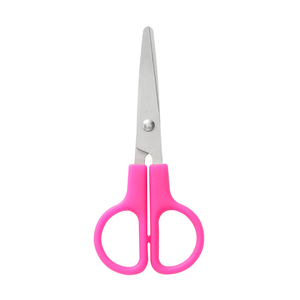
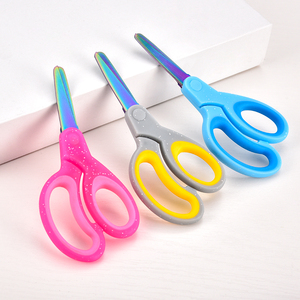
- 3Cr13 Stainless Steel (AISI 420J2 Equivalent): The benchmark alloy for commercial-grade household sewing tools, student craft scissors, and standard thread cutters. Containing 0.26%–0.35% carbon and 12.00%–14.00% chromium, 3Cr13 yields an optimal balance of corrosion resistance, structural ductility, and ease of sharpening. Following vacuum heat treatment, it consistently achieves an HRC rating of 52–54, ensuring long-term edge retention under daily textile clipping operations.
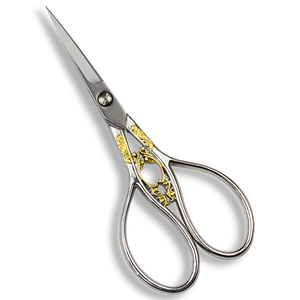
- 4Cr13 Stainless Steel (AISI 420C Equivalent): Utilized in professional-grade embroidery shears and fine-point detail scissors. Featuring a higher carbon content (0.36%–0.45%), 4Cr13 can be hardened to HRC 55–58. This elevated hardness allows master grinders to hone ultra-fine bevel angles (30° to 35°) capable of shearing delicate silk, synthetic filaments, and multi-strand embroidery threads without pushing or dragging fabric fibers.
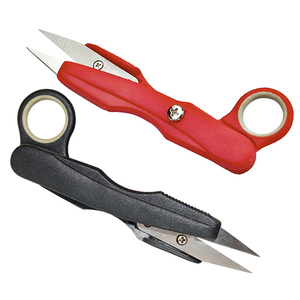
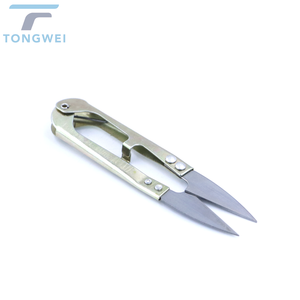
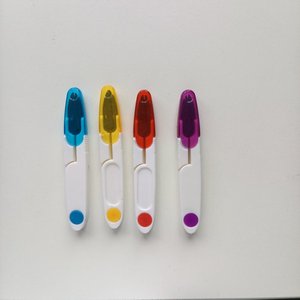
- High-Carbon Spring Steel (for U-Shaped Thread Snips): For industrial U-shaped thread clippers, high-carbon spring steel remains a popular choice due to its superior elasticity and fatigue endurance under continuous cycling. When treated with protective electrophoretic coatings or transparent anti-rust sheaths, these clippers deliver millions of rapid-rebound snips in high-volume apparel factories.
| Steel Alloy / Grade | Carbon Content (%) | Chromium Content (%) | Achievable Hardness | Recommended B2B Application |
|---|---|---|---|---|
| 3Cr13 Stainless | 0.26% - 0.35% | 12.00% - 14.00% | HRC 52 - 54 | Household DIY, Student Craft, Multi-purpose 5" Scissors |
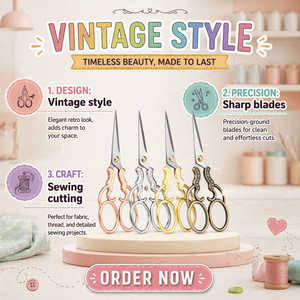
| 4Cr13 Stainless | 0.36% - 0.45% | 12.00% - 14.00% | HRC 55 - 58 | Precision Embroidery, Fine-Point Detail Shears, Vintage Stork |
| SK5 High Carbon | 0.80% - 0.90% | < 0.25% | HRC 58 - 60 | Industrial U-Shaped Thread Snips, High-Speed Garment Lines |
| 2Cr13 Stainless | 0.16% - 0.25% | 12.00% - 14.00% | HRC 48 - 50 | Budget Promotional Clippers, Disposable Safety Scissors |
2. Key Manufacturing Operations: From Steel Blank to Honed Blade
Achieving zero-gap shearing precision requires a multi-stage manufacturing workflow combining precision cold-stamping, automated CNC bevel grinding, controlled atmosphere heat treatment, and manual tension alignment.
Phase A: Die Stamping & Blanking
High-speed mechanical presses feed stainless steel coils into precision progressive die sets, blanking out scissor halves with micron-level dimensional repeatability. For specialized models such as asymmetrical-handle craft scissors or U-shaped clippers, the blanking step establishes the exact pivot hole location and handle ergonomics.
Phase B: Vacuum Heat Treatment & Tempering
Scissor blanks undergo computer-controlled vacuum furnace hardening followed by precise low-temperature tempering. This process transforms the soft austenitic steel matrix into hard martensite while relieving internal stresses, preventing blade warping across the lifespan of the tool.
Phase C: Hollow Grinding & Edge Honing
Unlike flat hardware knives, sewing scissors feature a subtle concave inner blade surface curvature (known as the "ride" or hollow grind). This geometry ensures that the cutting edges make point-contact only at the exact intersection of the two blades as they close. Advanced Chinese facilities utilize multi-axis CNC grinding machines to execute uniform hollow grinding, followed by robotically controlled or hand-honed blade sharpening.
Phase D: Assembly, Joint Calibration & Quality Inspection
The assembly phase involves joining the two blade halves via precision adjustable screws, smooth brass rivets, or high-tensile spring pins. Skilled technicians perform tactile torque testing—adjusting pivot tension so the blades slide smoothly without lateral wobble or excessive resistance. Every batch undergoes rigorous shearing tests across light tissue paper, loose yarn, and thick canvas prior to packaging.
3. Enterprise Manufacturing Advantages & Global Compliance
Referencing decades of industrial heritage—building upon established precision instrument crafting principles originating from leading global manufacturing hubs—top China OEM/ODM partners offer significant structural benefits for international buyers:
Strict Metallurgical Integrity
Full raw material traceability backed by Spectrometer Chemical Analysis and ISO 9001:2015 quality management systems. Guaranteed rust resistance and material stability.
End-to-End OEM & ODM Service
Comprehensive custom manufacturing including laser-etched brand logos, custom handle color matching (Pantone), ergonomic mold development, and blister pack packaging.
Global Regulatory Compliance
Products strictly comply with REACH (EC 1907/2006), RoHS, heavy metal limits (Lead, Cadmium, Nickel release standards), and US CPSIA safety requirements for student tools.
4. Future Procurement & Product Development Trends (2025–2030)
As the international textile, crafting, and stationery sectors evolve, global procurement managers must align their supply chains with key technological and commercial shifts:
Trend 1: Titanium PVD (Physical Vapor Deposition) Coatings
Modern consumers and commercial users demand enhanced aesthetics combined with functional surface protection. Titanium nitride (TiN) and titanium carbo-nitride (TiCN) PVD vacuum coatings provide striking multi-color rainbow, matte black, or rose gold finishes while boosting blade surface hardness above HV 2000, drastically reducing friction during high-speed thread snipping.
Trend 2: Eco-Conscious Bio-Resin & Recycled ABS Handles
Driven by European Union sustainability mandates, manufacturers are replacing traditional petroleum-based plastics with post-consumer recycled (PCR) ABS or hemp-fiber reinforced bio-polymers for asymmetrical scissor handles and protective safety sheaths without sacrificing drop impact strength.
Trend 3: Integrated Ergonomics & Hybrid Spring Mechanisms
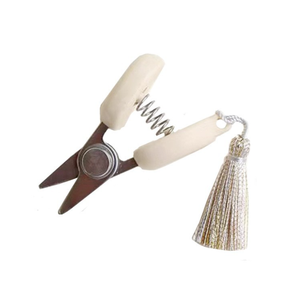
Repetitive strain injuries (RSI) in apparel production lines have prompted the development of self-opening spring-assisted mini scissors and ergonomic U-shaped clippers featuring soft TPR (Thermoplastic Rubber) over-molded finger pads, dramatically reducing operator hand fatigue.
Sourcing Checklist for B2B Importers:
- Verify manufacturer registration with relevant Chambers of Commerce and tax authorities.
- Request pre-production samples to test blade alignment, joint smoothness, and sharpness retention across target fabrics.
- Confirm packaging compliance (BARCODE, FNSKU, GSI-128 compliance) for retail or Amazon FBA distribution.
- Clarify Incoterms (FOB Ningbo/Shanghai, CIF, DDP) and bulk order lead times (typically 25–35 days).
5. B2B Sourcing FAQ: Frequently Asked Questions
What is the minimum order quantity (MOQ) for custom OEM small sewing scissors? +
Our standard Minimum Order Quantity (MOQ) for stock models with custom laser-etched logo branding is typically 1,000 to 3,000 pieces per article number. For complete custom handle color injection matching (Pantone) or custom blister card packaging, the standard production MOQ is 5,000 pieces per specification.
How do you guarantee quality consistency across large volume orders? +
We execute an AQL 2.5/4.0 inspection framework. Every production batch undergoes raw material spectral verification, automated Rockwell hardness testing post-heat treatment, 100% manual joint tension and cutting action verification, and salt-spray corrosion chamber testing to ensure zero rust formation during ocean transit.
Can we request samples prior to placing a formal bulk contract? +
Yes. We strongly encourage pre-production evaluation. Standard catalog samples are available within 3 to 5 business days. Customized OEM prototype samples with your laser logo or custom packaging mockups typically require 7 to 10 working days.
What stainless steel materials are best suited for embroidery vs. household craft scissors? +
For fine-point embroidery and detail sewing tools, high-hardness 4Cr13 stainless steel (HRC 55-58) is recommended due to its ability to hold a razor-sharp micro-bevel edge. For general household, student craft, and multi-purpose office scissors, 3Cr13 stainless steel provides high toughness, excellent corrosion resistance, and optimal cost-efficiency.
What are your standard export payment terms and shipping options? +
We support standard international banking terms including T/T (30% deposit upon PO confirmation, 70% balance against Bill of Lading copy) and Irrevocable L/C at sight. Shipping can be arranged under FOB, CFR, CIF, or DDP terms via ocean freight, air cargo, or international express couriers (DHL/FedEx/UPS).